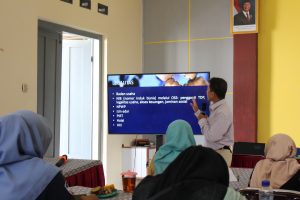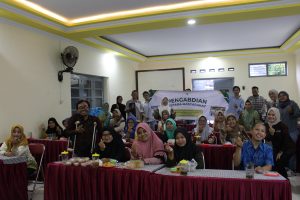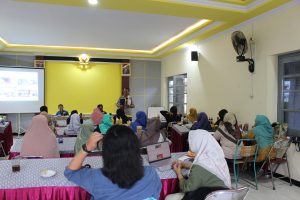

The Master of Agribusiness Management (MMA) Program, Faculty of Agriculture, Universitas Gadjah Mada, once again carried out a community service initiative aimed at strengthening the capacity of business actors at the village level. The program, titled “Strengthening the Institutional Capacity of MSMEs Assisted by KDMP of Sidoluhur Village,” was held on September 25, 2025, with Agus Dwi Nugroho, Ph.D. serving as the speaker.
The activity was attended by micro, small, and medium enterprise (MSME) owners who are supported by the Koperasi Desa Merah Putih (KDMP) of Sidoluhur Village. During the session, participants received a comprehensive introduction to key aspects of sustainable MSME development, ranging from business legality and financial management to marketing strategies and human resource management.
One of the main issues highlighted was the importance of business legality as a foundation for MSME development. The speaker emphasized that business owners need to have a clear legal business entity, a Business Identification Number (Nomor Induk Berusaha / NIB), and supporting certifications such as a Taxpayer Identification Number (NPWP), distribution permits (BPOM/PIRT), halal certification, and Intellectual Property Rights (IPR). These legal requirements not only serve as business protection, but also act as important prerequisites for accessing financing and expanding market reach.
In addition, financial management was also a major point of discussion. MSMEs were encouraged to begin keeping regular business records, both for income and expenditures. From the discussion, it became clear that most MSME owners in Sidoluhur had not yet implemented proper business record-keeping due to limited knowledge and the perception that the process is complicated. This situation presents both a challenge and an opportunity for more practical and ongoing assistance.
In terms of business development, participants were also introduced to the importance of business planning and marketing strategy. The use of digital platforms such as SIBAKUL was presented as one way to expand market reach and increase sales turnover. In addition, the preparation of a strong business profile was seen as an important first step in building branding and creating broader market access.
Another equally important aspect was human resource management. Many MSMEs still focus primarily on day-to-day business operations, while the development of human resource capacity often receives less attention. For this reason, training and competency development were emphasized as key elements in supporting sustainable business growth.
This activity forms part of MMA UGM’s commitment to supporting community-based economic development through entrepreneurship. More broadly, it contributes to the achievement of the Sustainable Development Goals (SDGs), particularly SDG 8: Decent Work and Economic Growth through strengthening MSME capacity, SDG 9: Industry, Innovation and Infrastructure through encouraging digitalization and business innovation, and SDG 17: Partnerships for the Goals through collaboration between universities, cooperatives, and local business actors.
Through this community service initiative, MMA UGM plays a role not only as a center of education, but also as an active agent of change in community empowerment. Its direct involvement in assisting MSMEs provides practical experience that is highly relevant to real-world conditions, while also strengthening the competencies of its graduates so they are better prepared to face the challenges of modern agribusiness.
Event Documentation: